About Dominique

http://dominiquegoh.com

Singaporean Educator, Coach and Hands on Mom of Three. Connect with me on Google+

Posts by Dominique:

Fun Cooking with CulinaryOn

{Media Invite}
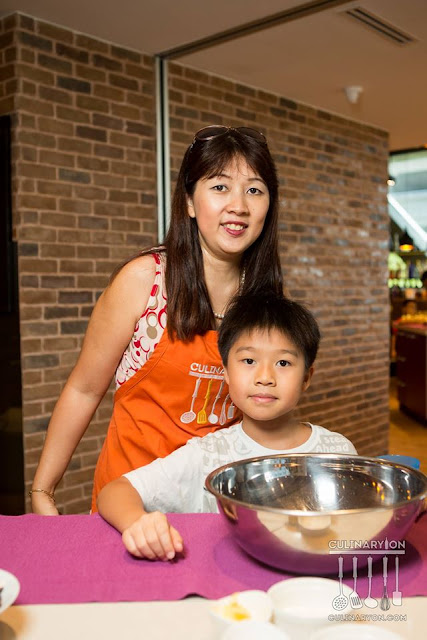
Doggie boy and me- Picture by Culinnaryon

Doggie boy and me- Picture by Culinnaryon


The kids and I enjoyed a fun cooking experience with Culinaryon this January. We were invited to learn how to make pasta and chocolate lava cake from the culinary chefs  at the cooking school.

Located at One Raffles Place the studio occupies 7000 sq ft  and has 4 event areas with 16 cooking stations, 4 chef tables and a well stocked bars.

Tiger girl and me

Tiger girl and me

We were treated to light refreshment with  some Hors d’oeuvre before the cooking session started.

The boys with their chef

The boys with their chef

It was a hands on workshop and the adults and kids were separated into different groups.

Monkey boy whisking the egg in a bowl.

Monkey boy whisking the egg in a bowl.

Tiger girl watching how the chef whisks the eggs

Tiger girl watching how the chef whisks the eggs

We started off making the Chocolate lava cake and were shown the steps that are taken to create the cake.

Melting the chocolate in a double boiler

Melting the chocolate in a double boiler

Making the chocolate that went inside the cake was a fun task. I got to see how the chocolate bits slowly melt under heat to form the chocolate sauce that was to ooze out from the cake.

Tiger girl seeing how the pasta dough was made

Tiger girl seeing how the pasta dough was made

Once the lava cakes were ready and placed in the oven to bake we started on pasta making.  The chef showed us how to make a well with the flour and place the eggs within it. Kneading it carefully the ingredients combined to form a dough.
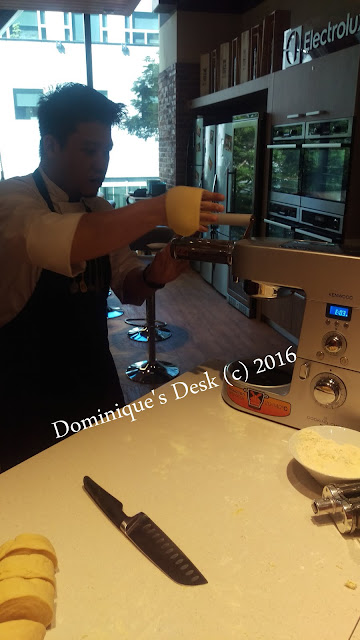
The chef putting the dough through the pasta maker

The chef putting the dough through the pasta maker

Once the dough had been made it was  cut into mini blocks before being sent through the pasta maker attachment to flatten it into sheets.

One flatten sheet of pasta

One flatten sheet of pasta

Pasta cutter

Pasta cutter

After the pasta had been flatten it was put through a cutter so that you get the noodle like pasta that you eat.

Monkey boy examining the pasta

Monkey boy examining the pasta

Monkey boy separating out the pasta

Monkey boy separating out the pasta

Once the pasta was made it was time to cook it.
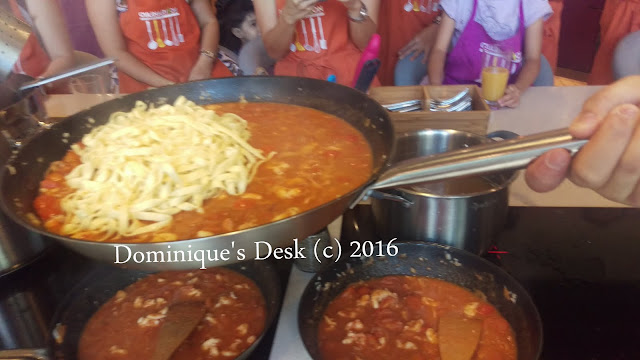
Cooking the seafood pasta

Cooking the seafood pasta

The adults had seafood pasta while the kids had two choices. They had either cream based pasta or tomato based one.

Seafood Pasta for the adults

Seafood Pasta for the adults

The two different pastas for the kids

The two different pastas for the kids

Doggie boy loved the creme sauce based pasta while Tiger girl preferred the tomato based one.

Monkey boy and me had the seafood pasta and it was certainly yummy!!

The chocolate lava cake served with ice-cream

The chocolate lava cake served with ice-cream

After pasta it was time for dessert  and the kids love the fact that they were served freshly made ice-cream made with nitrogen.

Tiger girl tucking into her dessert

Tiger girl tucking into her dessert

The molten chocolate oozing out from the cake

The molten chocolate oozing out from the cake


The kids watching the magic show

The kids watching the magic show

There was an entertainer there who put on a magic show for the kids after the food had been made. All of them were engrossed with his performance.

The boys seeking time alone with the magician

The boys seeking time alone with the magician

You could say that the boys were more interested in magic then cooking as they sourced out the magician halfway into their cooking lesson.  They were thrilled when he taught them a few different card tricks.

The certificate that all of us received

The certificate that all of us received

The afternoon ended off with the distribution of certificates which marked our participation in the class.

Have you attended a cooking/baking class

with your kids before?


Culinaryon Singapore

#04-63 Tower 2 , One Raffles Place

Singapore 048616

Disclaimer: We were invited to attend a cooking sessions for parents and kids at Culinaryon. All opinions are 100%  mine.

 

new button


Bridging the GAP- Upper and Lower Primary Science

Themes in Science

Themes in Science that are taught at the different levels.


Science is a subject which is introduced in Primary 3.  In the Singapore syllabus it is broken up into the Upper Block( Primary 5 and 6)  and  the Lower Block ( Primary 3 and 4) Many kids are fascinated and eager to learn about science as it gives them a change to conduct many hands on experiments.

The way that Science is taught differs from English and Chinese. There is a lot of focus on facts and being able to describe each item accurately and in detail. Basic facts in Biology, Chemistry and Physics are introduced to the students at this age to ease them into studying these subjects when they enter their secondary school years.

Difference between P3 and P4 Science assessments

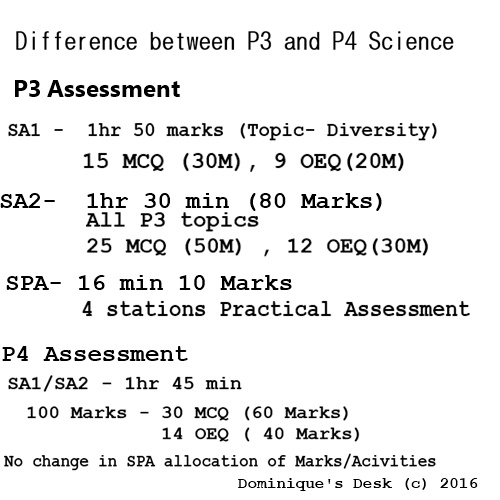
Difference between P3 and P4 Science assessments is that the paper gets significantly longer come SA2 with an additional  10 Multiple Choice Questions  and 3 Open Ended Questions. There is also an additional 45 mins allocated for the exam.  The number of questions tested is further increased in P4 where the student is given 5 more  Multiple Choice Questions and  2 more Open Ended Questions  to complete within the extra 15 mins given.

( Note that for the  P3 SA2 they are given 1hr 30 mins while in P4 it has been extended to 1hr 45 min. )

As you can see from the chart above the quantity of questions been asked in an assessment increases quite significantly from SA1 to SA2 in Pr 3. The student must be able to time manage efficiently to be able to complete the extra questions given as he progresses from one assessment to another.

The mode of assessment doesn’t different much from P4 to P5 and even P6  as each Science assessment is 100 marks.

There has been some changes to the Primary School Science syllabus lately and the 2014 P3 cohort will be the first one to sit for their PSLE under the new format.   This changes will affect Doggie boy as he is currently in Primary 4. Monkey boy is unaffected as he will be tested based on the old format this year for PSLE.

What are the changes?

The topics tests remain the same however the expectation of how the questions are to be answered is different. There is a greater emphasis on how a students words his answer to the question given.

The focus has shifted to the teaching of more in depth  knowledge of each topic that is taught.

For example in the topic on Diversity it is now required for the child to understand the essential takeaways besides the key inquiry  questions.

Essential Takeaways 

  • There is a great variety of living and non-living things around us.
  •  Man can classify living and nonliving things based on their similarities and differences to better understand them.
  •  Maintaining the diversity of living things around us ensures their continual survival.

Key Questions

  •  What can we find around us?
  •  How can we classify the great variety of living and non-living things?
  •  Why is it important to maintain diversity?

Previously there was only focus on  just the key inquiry questions in the old syllabus. Now the kids have to show how  much they understand from each topic and apply their knowledge adequately to the questions asked.

This can be rather difficult for kids who are poor in the language skill and/or have difficulty expressing themselves using the correct terminology.

How to tackle the new format exam then?

There isn’t any short cut to this. The student would need regular and constant revision to fully understand what has been taught during the science lessons.

He has to engage the following skills while doing taking an assessment.

For the Multiple Choice Section

  • Identify the topic
  • Eliminate all the possible wrong answers
  • Show his thought process leading to choosing the “right” answer.

For the Open- Ended Questions

  • Identify the topic
  • Highlight the Key information/ words
  • Show the thought process

During the 4 years of learning science a student is expected to cultivate the  following process skills

  • Comparing
  • Interpreting
  • Inferring
  • Applying
  • Analysing
  • Creating
  • Synthesizing
  • Generalizing
  • Evaluating

My thoughts

The current MY Pals science textbooks and workbooks do not give adequate practice nor information regarding the various themes.   In fact I find the text book very skimpy and one would have to supplement with other external information to give the student a  detailed/complete understanding of the theme taught.

The 3 periods dedicated to teaching of Science is also grossly inadequate as sufficient time to carry out all the experiments that they require to do within the syllabus  and go through all the factual information associated with it. A lot of reading up  and practice is required outside the classroom to ensure that concepts taught register with the child.

What are you doing currently to bridge the gap in  Science with  your child?

In the next installment in the series I will be reviewing what I had done last year when Doggie boy moved from  primary 2 to primary 3.

Bridging the GAP

Bridging the GAP

1) Bridging the Gap- An Introduction

2) Bridging the Gap-  Identifying the Gap in Chinese Language ( P4 to P5 )

3) Bridging the Gap- Reinforcing the Learning of Chinese

4)Bridging the Gap- Identifying the Gap between P4 and P5 English.

5)Bridging the Gap- Learning of English in Upper Primary

6) Bridging the Gap- Identifying the Gap between P4 and P5 Maths

7) Bridging the Gap –  Modelling and Methods  in Maths (Part 1) 

8) Bridging the Gap- Modelling and Methods in Maths ( Part 2)

9) Bridging the Gap- Upper and Lower Primary Science

10) Bridging the Gap- Moving from Lower to Upper Primary ( Part 1)

11) Bridging the Gap- Moving from Lower to Upper Primary ( Part 2)