This week I have been talking about learning sentence structure, using of visuals, story sequencing and graphic organisers. Today I will be focusing on competing the essay that Ryan and I started on the beach.
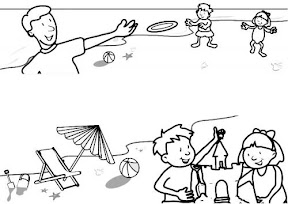
[Picture used to draw in the conversation]
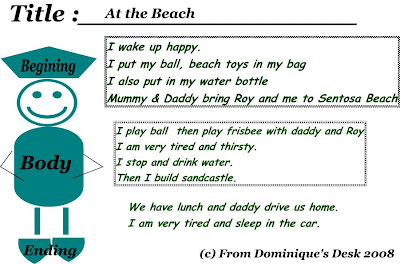
In Part 4 Ryan came out with this storyline
I asked him the question
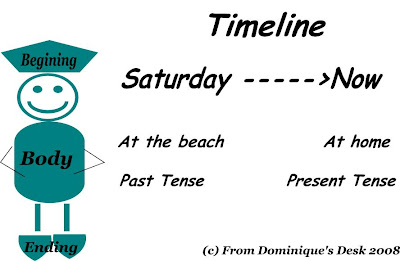
” When did we go to the beach? Are we at the beach now?”
He answered ” Saturday. No we are at home now.”
Ryan does know the concept of time but he is not that good at reading the time on a clock.
He is able to distinguish between today, yesterday and tomorrow.
” Have we gone to the beach? Did you play and enjoy yourself there?
He answered” Yes”.
I explained to him what we are doing are all based on a time line
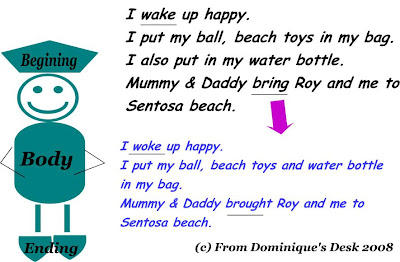
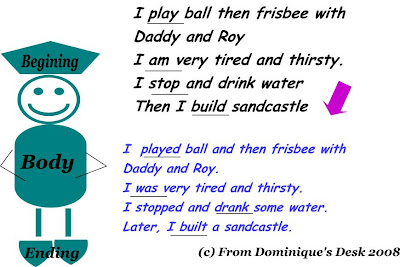
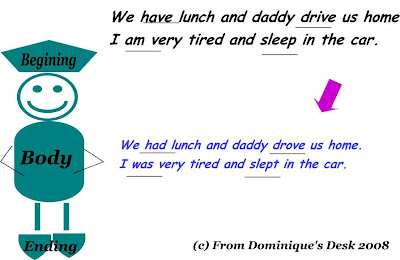
I explained to him that certain words will change when we are talking about this that had already happened (in the past) as compared to the present (now) Ie: Wake(present) – woke(past)
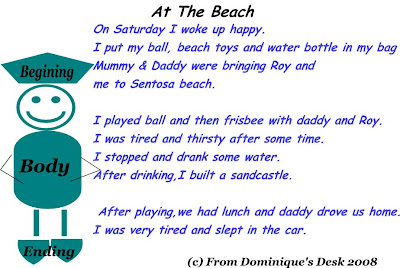
We corrected the two paragraphs that he came up with to change the tenses.
Ryan’s final composition after all the editing and help.
After seeing all the steps it is now your turn to try out writing with your kid(s). Have fun in the process. 🙂
The little girl is reading the storybook with her daddy.
I read storybook with mummy and Roy.
I though him to use the words.
In the Morning, Later , After and at night before bed
to join the sentences that he had earlier mentioned and we wrote down together.
The completed essay reads:
In the morning,Mummy wash and hang up the clothes
Later ,mummy cook dinner for me.Macaroni and cheese. My favourite.
At night before bed we sit together and read storybook .
The essay is not gramatically correct as he should have been using the past tense instead of the present tense. However since the emphasis is on building up the storyline it is quite an achievement for him I will teach him on when to use the correct tenses another time.
This right brain activity is suitable for kids from 4-6 years old.
For other examples on story sequencing cards you can get some printables from DLTK
Learning Goals for this activity:
Children will be able to:
-identify different object pictures.
-follow the sequence of the pictures to tell a story with a beginning, middle, and end.
– create their own stories using the picture cards.